Chapter Three
In the morning, she tiptoed past Mr. Holmes’s door and went to enquire about an early breakfast.
Later, when Mrs. Hudson brought coffee to the parlor, Jane needed another favor. “I’m writing the shipping company to send my luggage here. Will you accept it for me?”
“Certainly.”
“Could I have a stamp?”
The landlady returned with scones, marmalade, and a stamp Jane didn’t recognize, which did not please her at all. England wasn’t supposed to change during her absence. Weren’t the constant changes in her life enough?
Jane held the violet stamp up to the light. “What’s this?”
“They stopped making red penny stamps,” said Mrs. Hudson, “on account of people soaking off the postage marks to use them again. Just watch that you keep it dry.”
Thanking her, Jane went into the street looking for a pillar box.
Now that the shipping company would forward her luggage, she needed the money to pay for the service. She walked south along Baker Street, turning onto bustling Oxford Street where Marshall & Snelgrove Drapers attracted her with a dazzling shop window. The latest French fabrics would have pleased Mama, and she looked over her shoulder despite herself, in case her mother happened along.
Not likely.
Her parents and their servants seldom visited London in August, which was all to the good, as she was running an errand that hurt her pride. The Capitol’s curving roads and blind alleys sent her wandering and backtracking until she left the prosperous areas of town far behind.
This east-end neighborhood collected idle men at street corners, and women in shawls paced beside her, proffering baskets of apples or boiled eggs. On the other side of the street, gaunt flower sellers left her alone, preferring to chat up young men, of which there were many. Like Staffordshire, London teemed with youth. A gang of urchins played gully on the street, throwing and knocking down stones, while a trio of ragged girls stared at her. Instinctively, she kept a hand on her purse.
Quite turned around, she followed a sign into a side street to William Pawn Shop, distinguished from other pawn shops by a tiny crown sketched over the name. Where Marshall & Snelgrove had beckoned, its grubby windows and dirty façade repelled her senses.
Straightening her shoulders, she opened the door and let her eyes adjust to the gloom. Shabby goods sat on wooden tables; the more expensive items perched on shelves overhead. Alone in the shop, she wondered what to do if a ruffian came in and began stealing the silverware.
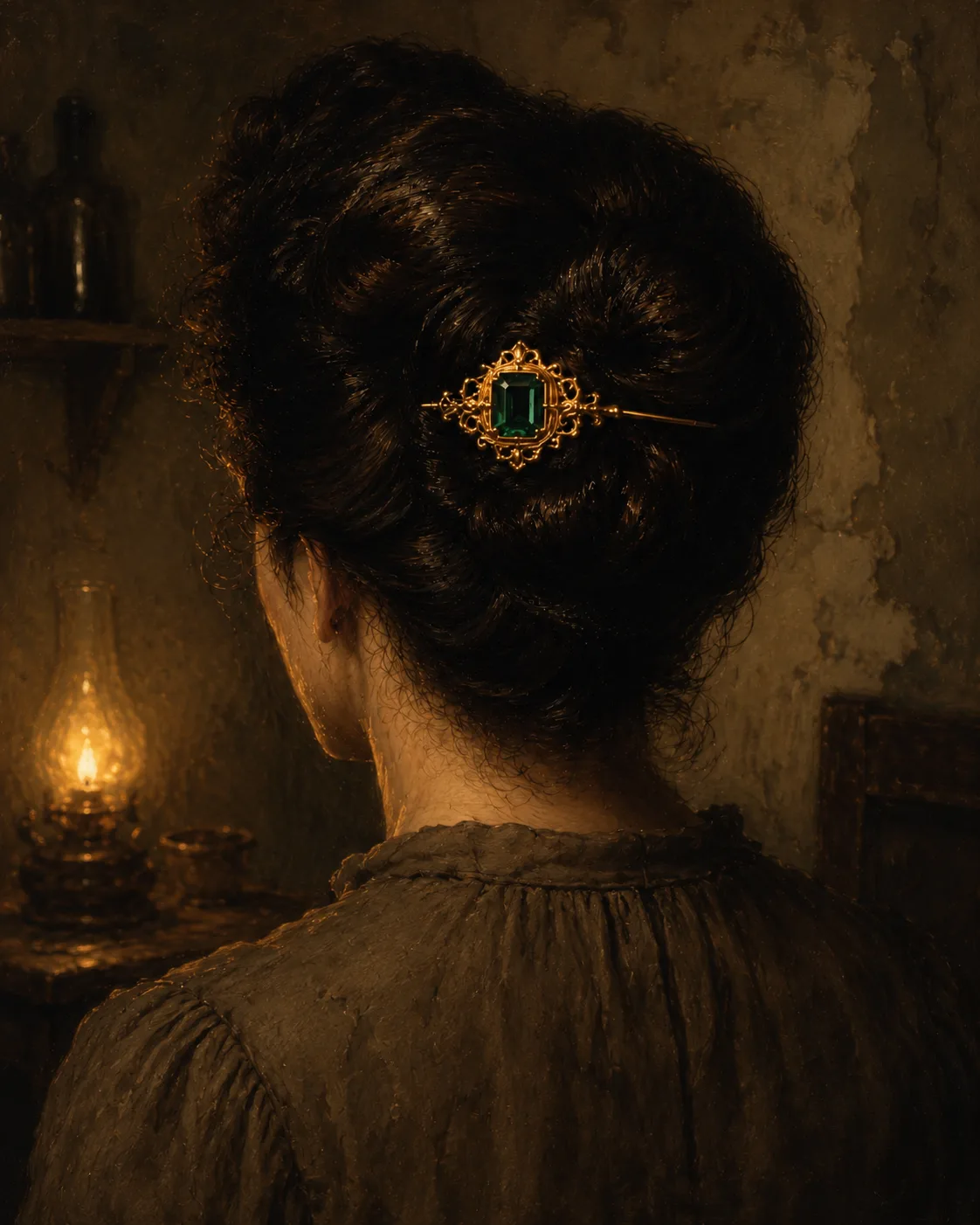
“Well, let’s have it,” ordered a gruff voice from a hidden back room. He had a pleasant-enough face, too young for his tobacco-broken voice, and when she stepped up to the counter, he reeked of last night’s gin. She pulled the emerald pin out of her hair and gave it a longing look despite herself. What a poor businesswoman she was, unable to hide her fondness for it.
“It’s an emerald set in gold, inherited from my aunt. What will you offer me for it?”
He picked it up, being sure to touch her palm with his unpleasantly warm fingers, but he barely glanced at it.
“Your aunt may have wished you the best, love, but this is paste and copper. I could give you something for it, but you’d be better off using it to pin up your pretty hair.”
“It’s worth ten guineas.”
One thing she’d learned from her father was that in negotiations, you started above the price you wanted and let the other party knock you down to the amount you could settle for.
“Guineas? It’s worth pennies.”
“I’ll have it back, then.”
She tried to snatch it out of his hand, but he came out from behind the counter, approached the shop window, and pulled a pair of pince-nez from his pocket, rather ostentatiously for a man of five and twenty.
“Maybe I could clean it up,” he said. “But ten guineas? It’s not even gold.”
“It’s a fine emerald, with a clasp made of gold filigree. I think you’ll find it’s worth the sum of the items you are selling on these shelves.”
“Well now. How did a humble creature like yourself come across such a thing? By the state of your dress, I would say you picked it off the body of an ailing patient. Maybe a dead one. Should I be hailing the police to witness this?”
“Do as you must. If you involve my family, I will have to own to pawning an heirloom, but I’m not the first heiress to need cash.” She smiled sweetly. “I’m sure that if I have nothing to hide, neither do you.”
He returned to the desk and drummed his fingers on a cash box.
“Very well, my dear. I offer you half a guinea for it.”
“Five guineas.”
“Four guineas.”
“Sold.”
Four guineas would support an honest family for as many weeks. It was much less than the brooch was worth, but she was pawning it, not selling, and fully intended to buy it back.
She waited nervously while he fumbled with his cash box, muttering to himself.
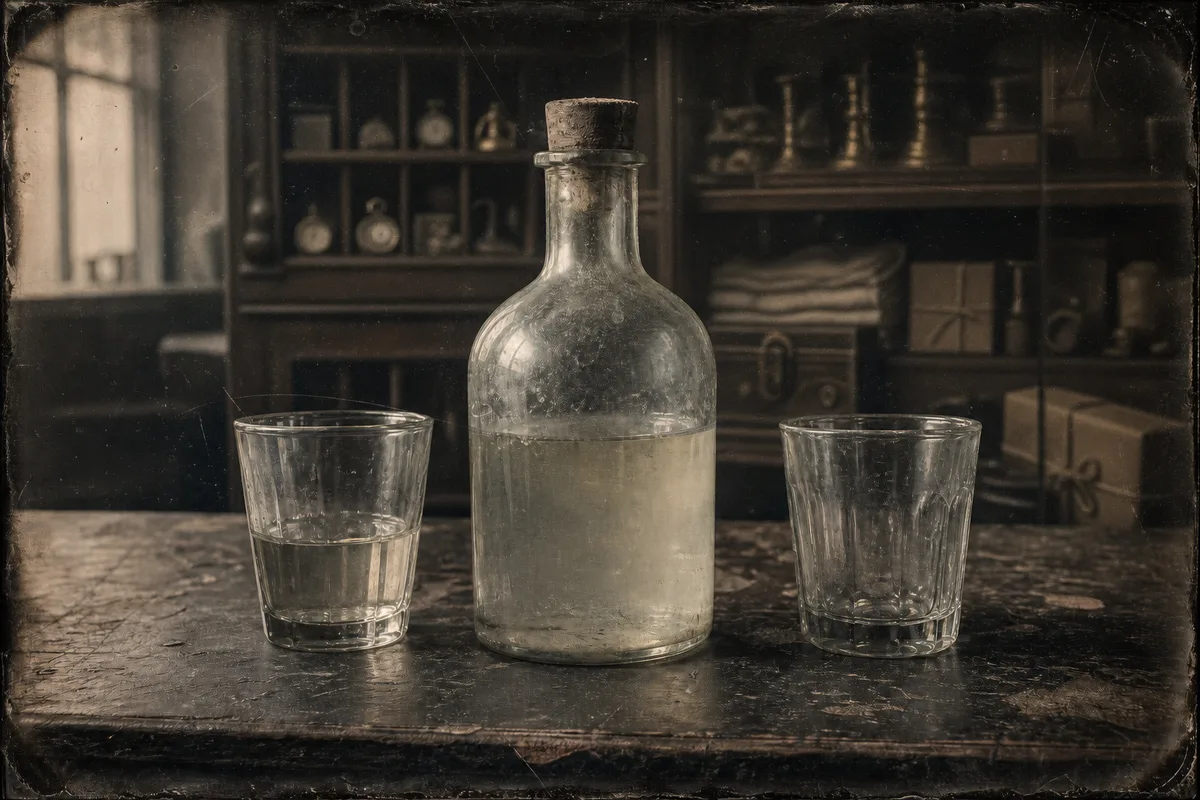
“Shall we toast our bargain?” He set a pair of glasses on the table beside a cloudy bottle of gin.
“No, thank you.”
All that remained was for him to count the worn coins and bills into her hand, which she scrutinized.
“What’s the matter, young miss?”
“My father warned me about counterfeit coins.”
“And you suppose London is full of crooks?”
“One can’t be too careful.”
The long walk and financial dealings had rendered her tired, thirsty, and hungry as she made her way home. Fortunately, she spotted a tea shop, the best place a lady alone could find refreshment.
Better still, when she opened the door, she noticed a selection of recent newspapers available for patrons. Settling at a small table with a cup of tea and a bun, she leafed through The Times, searching the advertisements for nursing situations. As ever, her plan was to study medicine in her spare time until she could qualify as a doctor.
The tantalizing scent of butter and fresh bread made her stomach growl. She bit into the bun with less than feminine delicacy but sipped the tea discreetly to make up for it. Unfortunately, the bun lasted for only a few bites, and she yearned to buy the Cornish pasty she had passed over for reasons of economy.
The Times mostly advertised private engagements, but Jane did not wish to pin herself down to one patient. She needed to learn by observing doctors in a hospital.
Switching to The Daily Telegraph, a portrait of her father stared back at her. The engraving resembled a daguerreotype in accuracy, and she recognized the facade of the mining office sketched behind him. The headline read:
Mine owner accused of murdering business partner.
She rushed into the street and hailed the first passing cab.
Reaching Baker Street, she knocked on Mrs. Hudson’s door, where she paid for the room and for accepting the charges for her trunks which the landlady, despite her frail aspect, helped her carry up the stairs. In her private room, she locked the door behind her and turned to the non-trivial task of dressing properly without a maid’s assistance. Mama despaired of her coiffure, because Jane lacked the patience to braid it tightly, but she put it up as best she could, regretting the loss of her emerald pin.
Mama would frown.
Except she wouldn’t care about hair or anything else with Papa in prison. Blinking back a tear, Jane faced the glass on the dresser and laced herself roughly into her corset.
What felt like hours later, she marched through the parlor and downstairs, knocking on Mrs. Hudson’s door in order to wish her goodbye.
“Where are your traveling bags?”
“I have this.” She hefted a carpetbag. “I shan’t be gone long.”
She stepped into the street and wondered if she should take the Metropolitan, but her father would think nothing of paying for two cabs in a day.
Now he’s in trouble, and I’m fretting over farthings?
Alighting at Euston Station, she was pleased to find a ladies’ carriage where a well-heeled miss could travel alone without raising questions.
Little did they know how she had spent the past six months caring for all sorts. She felt at home, surrounded by the maids and shop clerks dozing in their seats.
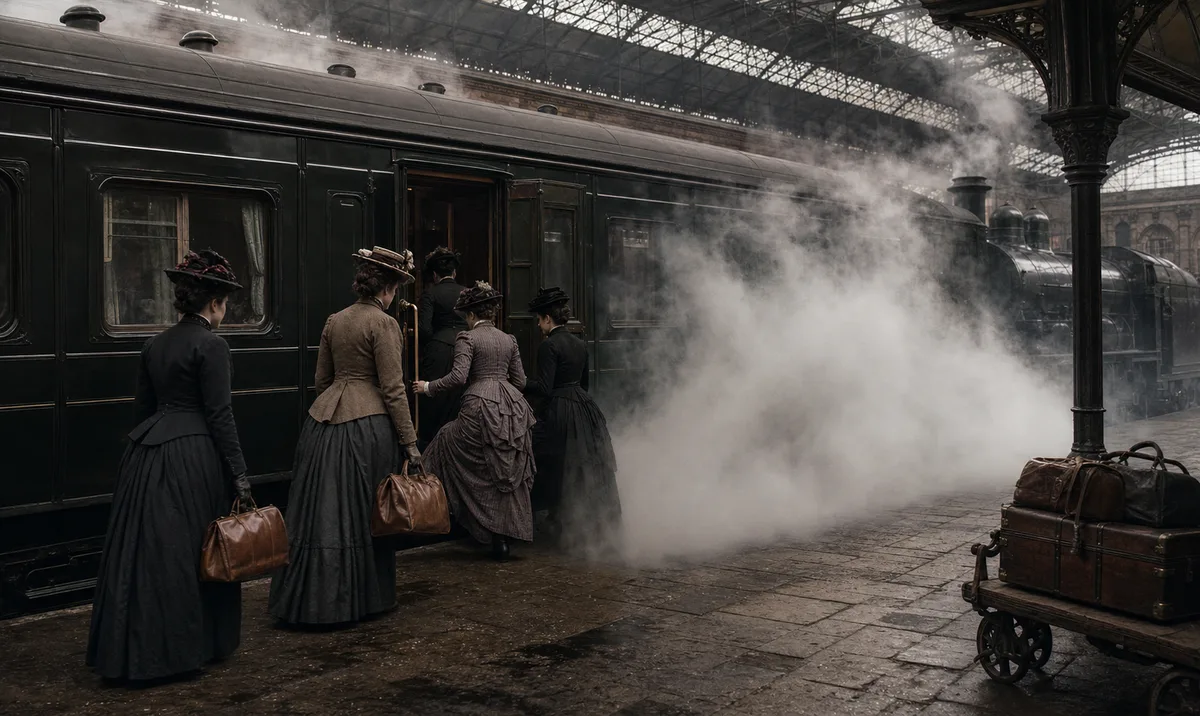
The train rumbled for hours, belching coal smoke which leaked into the compartment. She ignored the rattling and swaying movement as she read through newspapers hastily purchased at the station. Irish land reform was in the news, of course, with all that implied for Papa. He and his partner did not own the land the company mined but leased it from Lord Charterbridge.
As she searched The Illustrated Police News for further information about her father’s predicament, it seemed that this murder made the headlines because of economic and political interests tied to the mine. With assaults and robberies occurring daily, London crime could fill the papers without reporting on her industrial hometown.
She read the meagre facts of the case over and over, but there was nothing she could do before arriving. Eventually, the rocking train lulled her to sleep, and she did not awaken until late afternoon.
The gray sky sent rain drumming on the metal roof of the train, and gusts of wind lashed at the windows. Many fellow travelers had gone, their seats filled by newcomers, a real cross-section of society. Some dressed like coal miners’ wives or farmers, while a few dressed almost as finely as herself.
One bundled-up matron, at the far end of the compartment, had maintained the same posture since the beginning of their journey. She leaned up against the wall, her face obscured by a shawl, her sturdy frame encased in boots and a heavy wool coat that she did not remove despite the overheated carriage.
Her newspapers finished, Jane offered them to a nun in a plain dark habit and veil, who took them with a smile and offered her a ripe pear in return.
“I’m most obliged.”
She’d eaten nothing since the buttered roll, and the flavor was delicate and meant to be savored. Jane was still dabbing pear juice off her lips when they pulled into the station.